NAVIGATION:BROKEN in Amsterdam. 20 August - 9 September 2026
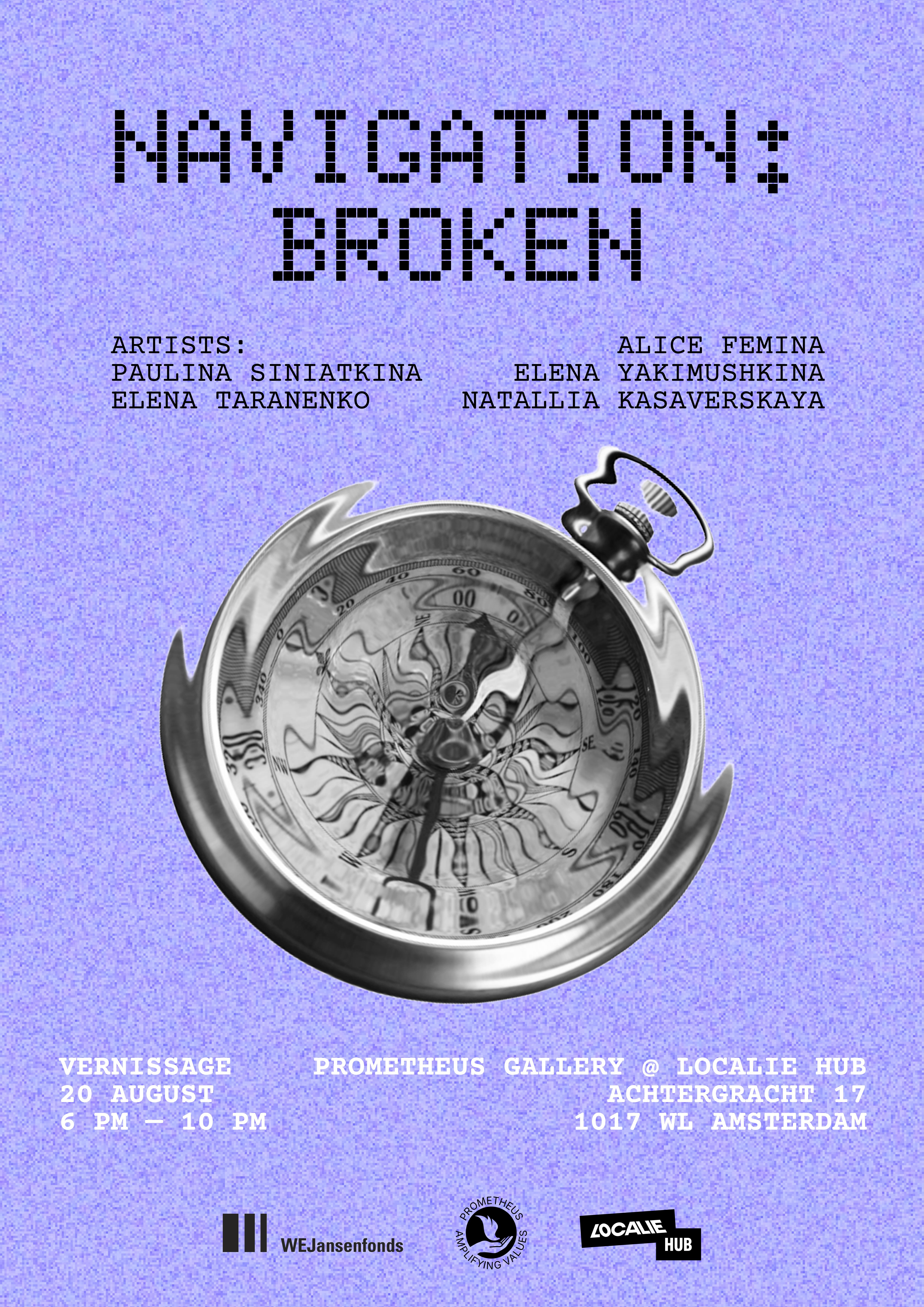
The relationship between Russia and the Netherlands begins with an image of navigation: a young tsar travels to a European shipyard for the craft of shipbuilding and returns not so much a master as the bearer of a new symbolic axis — a course by which the country will orient itself for three centuries. The "window to Europe" is, in this sense, not a metaphor of openness but an operation by which a subject is constituted through an external point of reference. It is precisely this axis that has been dismantled before our eyes: a war launched by Russia at the centre of Europe, a downed Dutch airliner, repression at home — not episodes of cooling, but the destruction of the very mechanism by which the two countries had historically certified one another. The compass has not simply drifted. It has ceased to exist as a shared instrument.
But it is precisely where the official, state-level relation breaks that another level is exposed — one that has always existed in parallel, irreducible to diplomacy. In this situation, culture does not so much "continue the dialogue" as produce a different subject for it: not the state, but the body; not the agreement, but the biography, forced to become an instrument of connection in its own right. The artists gathered in this project did not choose displacement as a position — it was imposed on them by history — but it is precisely out of what was imposed that they construct a method, and this is the decisive shift: rupture ceases to be pure negativity and becomes the condition for producing a new experience, a new — provisional and internally heterogeneous — community.
This community is not organized around a shared language or a shared position; it holds together through the shared experience of a failed instrument, and each work proposes its own, irreducible version of how to orient oneself once the map has been lost. For Natallia Kasavarskaya, disorientation is interiorized: the static, layered silhouette is not inaction but a form of holding the subject in place once external coordinates no longer guarantee anything. Elena Taranenko turns architecture into a bearer of memory: her Poppenhuis: Memory Model, a cardboard reconstruction of a Russian home built from memory alone, enters into dialogue with the very form of the Dutch dollhouse — miniature here functions not as diminishment but as the only scale still available to what has been lost. In Paulina Siniatkina's work, the archive of displacement is inscribed at the level of the body: the X-ray, originally an instrument of institutional control and silence, is re-signified as portrait — the scar ceases to testify to damage and becomes the trace of a passage successfully made. Alice Femina turns the exhibition's central metaphor into something close to a diagram: the breached wall of the old system, the red crosses of a new coat of arms hovering as still-illegible pixels, and the bureaucracy of asylum rendered as a labyrinth of clichés navigated with irony rather than despair. Elena Yakimushkina finally brings the logic of the exhibition to a clear formula: her paired ceramic cages, one always occupied and the other always empty, function simultaneously as a question and an answer: what could we take with us when our sense of direction has been disrupted?
NAVIGATION:BROKEN does not restore the instrument named in its title, nor does it offer a new coordinate system in place of the one that was lost. It asserts disorientation as a productive, and not merely traumatic, regime — one in which the connection between the two countries does not disappear along with the state dialogue, but continues in the body, in memory, in irony, in the ongoing act of artistic production itself. Navigation, broken as a system, survives — as it always has — as a practice.
exhibition working hours:
SAT + SUN 12PM-6PM
catalog of the exhibition available HERE


